
The Architectural Power of Porcelain Pavers
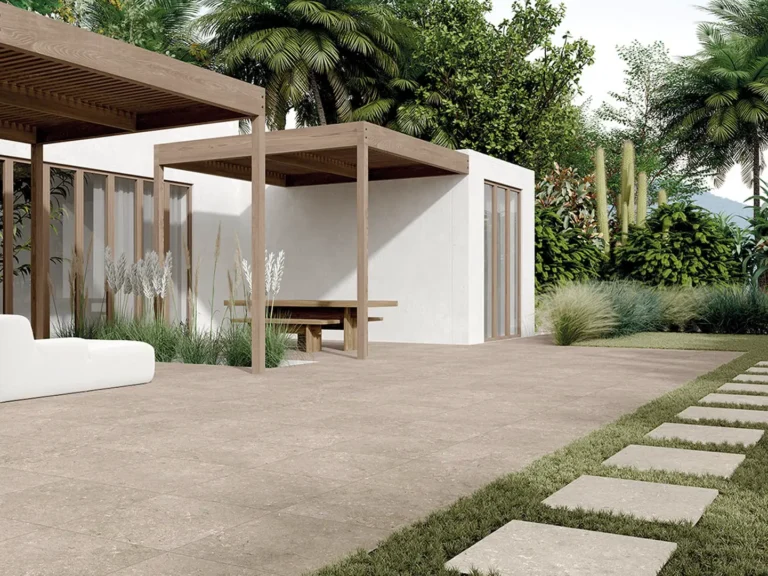
Porcelain Pavers have become the material of choice for high-end design, perfectly enabling the modern architectural trend of a seamless indoor-outdoor transition. This shift, driven by open plans and client demand for a “resort-like” feel, requires materials that are visually continuous and perform flawlessly under varying conditions.
What Makes Porcelain Pavers Different From Traditional Outdoor Materials?
Porcelain pavers are engineered to solve the problems that plague natural stone, concrete, and wood:
| Problem with Traditional Materials | Porcelain Solution |
| Stone stains, fades, or spalls | Porcelain is non-porous & UV stable |
| Concrete cracks in freeze–thaw | Porcelain meets ASTM C1026 (frost-proof) |
| Wood warps, splinters, discolors | Porcelain remains stable for decades |
| Composite decking heats up | Porcelain offers lower heat absorption |
| Pavers shift or settle | Porcelain works with pedestal systems |
Porcelain pavers deliver the sophistication, elegance, and pleasant texture of natural materials — without their weaknesses.
Explore Raphael’s Outdoor Solutions →
Performance Engineering: Why Porcelain Pavers Outperform Everything Else
1. Exceptional Density & Water Resistance
Most porcelain pavers have water absorption rates below 0.5%, meeting or exceeding ASTM C373 requirements for “impervious” materials, ISO 10545-3 classification. This is the #1 reason they succeed where concrete and stone fail. Why this matters? With porcelain pavers, you it will not freeze nor have thaw cracking, you won’t have the efflorescence. In addition, there is no mold growth and no moisture expansion. In short, in humid climates or areas with dramatic temperature swings (Northeast, Midwest), porcelain is the only long-term solution that consistently performs.
2. Slip Resistance That Meets Commercial Safety Standards
Porcelain pavers achieve DCOF ≥ 0.60 (ANSI A326.3 – Wet Areas) and R11 / R12 slip ratings for high-traction applications. This makes them ideal for different applications such as pool decks, hotel terraces, public plazas, rooftop amenities and walkways & commercial environments. Just where natural stone becomes slippery when wet, porcelain remains safe.
3. UV Stability and Permanent Color Through-Body Design
Unlike concrete pavers or composite decking porcelain color is fired at over 2200°F, pigments are mineral-based, its patterns and tones remain stable for decades and there is no fading, yellowing, or bleaching under the sun. Accelerated UV tests (ISO 10545-16) show color shifts ΔE < 1.0, invisible to the human eye even after years.
4. Heat Management: Cooler Underfoot Than Most Hardscape Materials
On a 95°F day, here is the list of the different materials and its resistant to different temperatures:
- Dark concrete: ~150–160°F
- Bluestone: ~155°F
- Composite decking: ~140°F
- Wood decking: ~135°F
- Porcelain pavers (light colors): ~125–135°F
This is a major advantage for pool decks, rooftop lounges, barefoot areas and luxury residential patios.
5. Structural Strength for Heavy Duty Use
Porcelain pavers are engineered with compressive strengths often exceeding 9,000 PSI, outperforming concrete and many natural stones. Suitable for restaurant patios, commercial courtyards, driveways (on mortar or reinforced base), exterior walkways and rooftop installations. This durability translates to zero callbacks for surface failure — something developers love.
Installation: What Architects and Contractors Need to Know
Porcelain pavers offer multiple installation methods depending on the design intent and structural conditions.
1. Sand-Set Installation (Patios & Walkways)
Use 4–8″ compacted aggregate base, with a 1–2″ leveling layer, 2% slope for drainage. The Edge restraints are required and the joints have to be 3–6 mm. This method is ideal for landscapes, garden paths, and residential patios.2. Pedestal System (Rooftops, Terraces, Balconies)
Porcelain pavers are the #1 material used in pedestal systems in urban architecture. Pedestal setup has to be with adjustable heights from 1″ to 24″, with a built-in slope correction, with an excellent drainage flow and utilities concealed (electrical, plumbing, lighting). This is used widely in luxury condos, as well as hotels, commercial rooftops and multi-family amenities The combination of lightweight 20mm pavers and pedestal systems is unmatched.
3. Mortar-Set Installation (Commercial Plazas & Heavy Traffic Zones)
Use a concrete slab substrate, with a medium-bed mortar (ANSI A118.15), with expansion joints every 16–20 ft, as well as epoxy grout for exterior use. Also install waterproofing membranes where needed. This is the most structurally robust configuration and is used in civic projects, hotels, and retail plazas.Design Advantages: The True Magic of Porcelain Pavers
Indoor–Outdoor Matching Collections
This is something NO natural stone can deliver. Porcelain manufacturers produce indoor tiles in 9–10 mm, as well as outdoor pavers in 20 mm with matching textures, patterns, and colors. This allows projects to achieve one material palette, two performance grades. As an example: our Calacatta Statuario is polished 10mm for interiors and structured R11 20mm for exteriors. It is the perfect visual continuity you are looking for.
Minimal Variation & Maximum Predictability
Porcelain offers controlled aesthetic variation:
- V1 = uniform
- V2 = slight
- V3 = moderate
- V4 = dramatic
When Stone is ALWAYS V3–V4 (unpredictable), porcelain lets designers specify exactly what the project will look like.
Perfect for Large Sliding Door Systems
When a home has 12ft sliders, as well as accordion glass walls and floor-to-ceiling openings, the flooring MUST match inside and out. Porcelain is the only material that handles sun, rain, snow, chemicals, static load, freeze–thaw, heavy foot traffic and ADA slip requirements…while still matching interior finishes perfectly.